Charges Unsealed Against Russian Spy Network for Assassination Plots
The U.S. Department of Justice has unveiled charges against members of an alleged Russian intelligence network accused of plotting targeted assassinations in the United States and Europe. The indictment highlights a broader effort by the Russian state, identifying key suspects and their recruitment tactics for carrying out these operations.
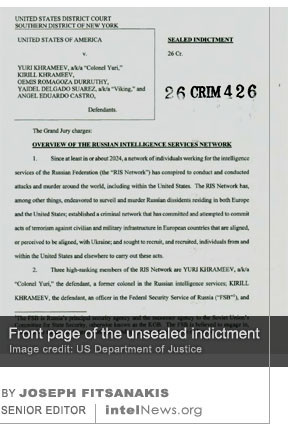
The U.S. Department of Justice recently unsealed charges against members of an alleged Russian intelligence network involved in planning a series of targeted assassinations in both the United States and Europe. This indictment reveals the existence of what has been described as a "global assassination network" associated with the Russian state, specifically linked to the intelligence services of the Russian Federation, known as the RIS network.
Among the accused are three individuals believed to be senior members of this network: Yuri Khrameev, 63; his son Kirill Khrameev, 27; and Oemis Romagoza Durruthy, 35. Yuri Khrameev is a retired intelligence officer who claims to have reached the rank of colonel and has previously stated that he worked alongside Russian President Vladimir Putin. Kirill Khrameev is thought to hold a mid-level position within the Federal Security Service (FSB) of Russia. Durruthy is recognized as a prominent figure within the Cuban expatriate community in Russia and has operated internationally as a member of the RIS network.
The Dead Drop Gift Shop
Sponsorship mission accomplished.
The indictment also names Yaidel Delgado Suarez, known as "the Viking," another Cuban expatriate residing in Russia, and Angel Eduardo Castro, a 22-year-old Venezuelan. Notably, all five suspects are currently at large and are believed to be living in Russia. The Khrameevs and Durruthy hold Russian citizenship, while Durruthy and Suarez are also Cuban nationals, and Castro is identified as a Venezuelan national residing in Russia. It remains unclear whether Suarez and Castro possess Russian citizenship, although it is likely.
According to the indictment, in the summer of 2026, Suarez and Castro recruited a Venezuelan citizen living in the New York area, referred to as "Resident 1," who was tasked with conducting reconnaissance near the residence of an exiled Russian dissident. In exchange for his assistance, Resident 1 was promised between $1,000 and $1,500, along with a potential $40,000 for carrying out the assassination of the target, an offer he ultimately declined.
Further Recruitment Attempts by the Network
Additionally, the same network attempted to recruit an American citizen residing in Vilnius, Lithuania, to assassinate a Russian expatriate living there, who was allegedly "telling lies about Russia." This American recruit met with the younger Khrameev at the Estonia-Russia border, where he was initially paid $200 for surveillance and later offered $25,000 for the assassination. When he declined, he was presented with a smaller sum to destroy an electrical substation or warehouse in Lithuania.
The existence of a dedicated Russian intelligence-led assassination network has been acknowledged in open-source intelligence since at least 2019. However, these indictments mark the first time named individuals have faced charges for attempting to carry out an assassination on U.S. soil, rather than in Europe.
Implications of the Indictments
The decision to publicly indict and name these five individuals, all of whom are believed to be safely residing in Russia, raises questions about the effectiveness of international law enforcement in dealing with such cases. It appears to eliminate any possibility of a surprise arrest while they are outside of Russia. This approach may align with the Trump Administration’s previously noted pro-Russian stance, indicating a complex interplay of politics and international espionage.
The broader implications of these charges extend beyond the individuals involved, as they highlight the ongoing threat posed by Russian intelligence operations globally. The recent indictments serve as a reminder of the persistent risks associated with state-sponsored espionage and the lengths to which such networks will go to achieve their objectives. As the international community grapples with these developments, the need for vigilance and cooperation among nations becomes increasingly critical in countering such threats.