U.S. Indicts Russian Spy Agency for Assassination Plot in Mexico
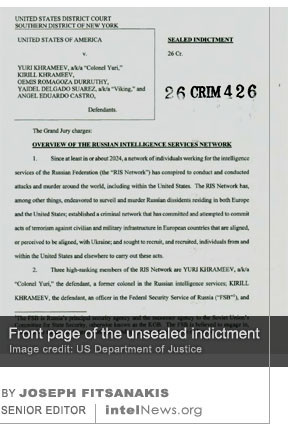
Recent indictments from the U.S. Department of Justice reveal a Russian intelligence cell's plot to assassinate a dissident in the United States, with operatives based in Mexico. The investigation uncovered a recruitment scheme involving a Venezuelan national who was paid to surveil the intended target, highlighting concerns over Russian espionage activities in North America.
A series of indictments filed by the U.S. Department of Justice has unveiled the inner workings of a Russian intelligence cell that was allegedly planning an assassination on U.S. soil. Central to this case is a team of operatives reportedly operating from Mexico, tasked with surveilling a prominent Russian dissident residing in the United States. The investigation began over the summer when the Russian network recruited a Venezuelan national living in the U.S. to gather intelligence on the target. This individual was compensated $1,500 for his efforts and was promised an additional $40,000 for the assassination itself.
Court documents indicate that the group included three Russians, one Cuban, and one Venezuelan, all of whom were involved in orchestrating the plot. Among them, Yaidel "Viking" Delgado Suarez, a Cuban national, communicated through encrypted apps about the pressure he faced from his superiors to execute the assassination. He mentioned having a team in Mexico ready to carry out the hit, although they were reportedly occupied at the time.
The Dead Drop Gift Shop
Sponsorship mission accomplished.
The indictment, filed in the Southern District of New York, lists the defendants as fugitives believed to be in Russia. Notably, the identity of the U.S. resident who conducted the surveillance remains undisclosed, as do any potential charges against him. The court documents paint a picture of a clandestine operation that underscores the growing concern regarding Russian espionage activities in Mexico, often masked under diplomatic pretenses.
What the Record Leaves Behind
In a related context, the U.S. Department of State recently highlighted the increasing presence of senior Russian spies in Mexico, which has raised tensions between the United States and its southern neighbor. This situation is reminiscent of past incidents involving Russian nationals in the region, including the arrest of Timur Praliev, a Russian mercenary associated with the Wagner Group, who was apprehended in Texas in early 2025 while attempting to enter the U.S. under dubious circumstances.
The implications of this case are significant, as it reflects broader geopolitical tensions and the lengths to which foreign intelligence services may go to target dissidents. It raises questions about the effectiveness of counterintelligence measures in the U.S. and the potential risks posed by foreign operatives operating within its borders. As investigations continue, the spotlight remains on the methods and motivations of the Russian intelligence community, particularly in their efforts to silence opposition abroad.