Star Trek's Aerospace Connections and Emmy Aspirations
As Star Trek celebrates its 60th anniversary, Glen Swanson explores how creator Gene Roddenberry leveraged his connections in the aerospace industry to enhance the show's credibility and boost its chances for Emmy recognition. Through strategic endorsements and targeted advertising, Roddenberry aimed to position Star Trek as a serious contender in the realm of television awards, showcasing its scientific and technological themes.
This year marks the 60th anniversary of the network television premiere of Star Trek. During the show’s original airing from 1966 to 1969, Gene Roddenberry aimed to create a science fiction series that engaged viewers through clever storytelling and modern visual effects, all while embedding his narrative within a believable scientific and technological framework. Roddenberry, a former World War II pilot, utilized his connections in the aerospace industry to enlist knowledgeable individuals and agencies to lend credibility to his show, elevating Star Trek's profile among influential figures in science, industry, and the military.
One notable strategy involved the use of endorsements from the aerospace community to draw attention to Star Trek, particularly as Roddenberry sought to secure an Emmy nomination. This article examines an early Star Trek advertisement as an example of how Roddenberry sought support from the aerospace sector to bolster the show's recognition. Additionally, it will look at the various awards the series received during its original run, including the prestigious Hugo Award.
The Dead Drop Gift Shop
Sponsorship mission accomplished.
The Emmys, akin to the Oscars in the film industry, carry significant prestige, not just for winning but also for being nominated. To be considered for an Emmy, shows must submit their entries to the Academy of Television Arts & Sciences. During the era of Star Trek, studios promoted their Emmy submissions primarily through advertisements in trade publications, hoping to capture the attention of voters. In anticipation of the 1967 Emmy Awards, Desilu Productions, the studio behind Star Trek, began placing ads in Variety, the leading industry trade publication.
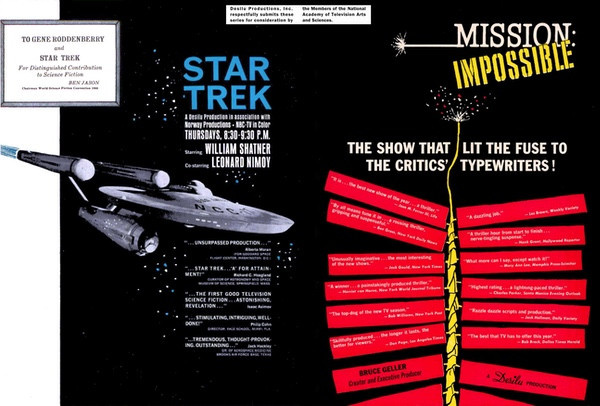
Shortly after NBC announced the renewal of Star Trek for a second season, Desilu published a full-page ad in the March 14, 1967 issue of Daily Variety, celebrating the renewal while simultaneously promoting the show for Emmy consideration. Just weeks before the Emmy nominations were announced, Desilu ran another ad, this time alongside a full-page ad for Mission: Impossible, another popular series produced by Desilu. Together, these ads aimed to capture the attention of the National Academy of Television Arts and Sciences.
Both advertisements featured endorsements from individuals in science fiction, the military, NASA, and educational institutions, many of whom were relatively unknown. The ad for Mission: Impossible was striking, using vibrant colors to depict explosive elements, while the Star Trek ad featured the iconic starship Enterprise against a cosmic backdrop. Despite their differences, both ads were designed to promote action-packed television.
Controversies Surrounding Star Trek's Endorsements
Critics have suggested that some endorsements in the Star Trek ad may have been solicited or contrived by Roddenberry, who was known to stretch the truth. For instance, Alberta Moran, an assistant at NASA’s Goddard Space Flight Center and a Star Trek fan, played a significant role in connecting Roddenberry with the aerospace community. Her endorsement, along with others, was strategically included in the ad to bolster the show's scientific credibility.
Moran’s relationship with Roddenberry was strengthened when she invited Leonard Nimoy, who portrayed Mr. Spock, to the Goddard Memorial Dinner, an event celebrating contributions to space science. This connection exemplified how Roddenberry cultivated relationships within the aerospace community to enhance Star Trek's reputation.
What the Record Leaves Behind
Among the endorsements was Isaac Asimov, a prominent science fiction author who initially criticized Star Trek but later became a supporter. His praise in the ad highlighted the show's impact on American culture and its role in popularizing science fiction. Roddenberry's ability to secure endorsements from respected figures like Asimov not only lent credibility to Star Trek but also helped distinguish it from other television offerings.
In conclusion, Gene Roddenberry's strategic use of endorsements from the aerospace community played a pivotal role in elevating Star Trek's status and bolstering its chances for Emmy recognition. By aligning the show with credible voices in science and technology, Roddenberry sought to ensure that Star Trek would be remembered not just as a television series but as a significant cultural phenomenon that resonated with audiences and critics alike.