Malware Command-and-Control: The Rise of Blockchain-Based Dead Drops
The evolution of malware command-and-control (C2) infrastructure has shifted towards decentralized blockchain networks, making it increasingly difficult for defenders to disrupt malicious operations. This article explores how threat actors utilize various techniques, including dead drop resolvers and smart contracts, to enhance the resilience of their C2 channels, creating new challenges for cybersecurity efforts.
The command-and-control (C2) channel serves as the backbone of any persistent malware campaign, yet it remains the most vulnerable aspect. When a C2 infrastructure is identified, the operational capability of the malware campaign collapses. Over decades, this vulnerability has spurred an arms race in resilience techniques, evolving from fast flux DNS evasion to decentralized architectures. Traditional C2 setups, where malware communicates with a hardcoded domain or IP address, are inherently fragile. Security researchers can disrupt operations by identifying these addresses, triggering responses from hosting providers, domain registrars, and law enforcement. This model creates a single point of failure that can render sophisticated malware inactive once its C2 is identified and sinkholed.
In response, threat actors have hardened their C2 infrastructures with various evasion techniques. Some of the most notable methods include domain generation algorithms (DGA), content delivery network (CDN) domain fronting, peer-to-peer (P2P) architectures, and dead drop resolvers. DGAs replace static domains with dynamically generated ones, making it difficult for defenders to neutralize operations through simple domain seizures. Security researchers counteract this by reverse engineering algorithms to predict future domains and applying machine learning to detect generated strings.
The Dead Drop Gift Shop
Sponsorship mission accomplished.
CDN domain fronting exploits discrepancies in encrypted web traffic to mask malicious communications, while P2P architectures eliminate centralized points of failure by allowing infected hosts to communicate directly with one another. Dead drop resolvers utilize third-party web services as covert repositories for operational details, complicating detection efforts. These techniques, however, still depend on some centralized infrastructure that can potentially be neutralized.
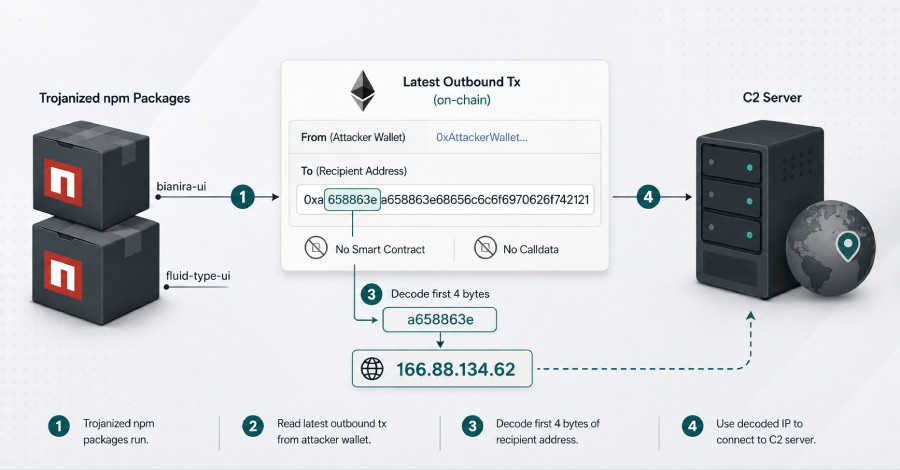
The introduction of public blockchains has transformed the landscape by embedding encrypted server addresses directly into transactions, creating an indelible record that cannot be deleted or altered. Once a transaction is confirmed, it becomes a permanent record, ensuring high availability and persistent access. This shift allows threat actors to circumvent traditional defenses, as no single entity can take down the blockchain records. The Bitcoin blockchain was first adopted for this purpose around 2016, with the Glupteba botnet being one of the earliest examples of using Bitcoin transactions for C2 updates.
Emerging Tactics in Blockchain Exploitation
As threat actors have increasingly turned to blockchain technology, they have also begun utilizing smart contracts on platforms like Ethereum. Smart contracts function as autonomous applications that can store data and respond to subsequent transactions, providing a more resilient method for hosting C2 configurations. The technique known as EtherHiding has emerged, where threat actors deploy smart contracts to hold encoded C2 domains. This allows malware to retrieve operational details without leaving transactional footprints on the blockchain.
The Final Read
The rise of blockchain technology has not only been embraced by cybercriminals but also by state-sponsored actors. Groups like UNC5342 have integrated these methods into their operations, demonstrating the widespread adoption of blockchain for C2 purposes. Furthermore, adversaries are leveraging multi-chain systems, such as TRON, to construct resilient communication channels, complicating efforts to disrupt their activities.
As the landscape of malware command-and-control continues to evolve, the implications for cybersecurity are profound. The use of decentralized technologies poses significant challenges for defenders, who must adapt to a new reality where traditional methods of disruption may no longer suffice. This ongoing arms race between threat actors and defenders highlights the need for continuous innovation in cybersecurity practices to effectively counter these emerging threats.